
Unveiling Bloom’s Taxonomy: A Blueprint for Effective Learning
Education and learning have transformed significantly over the years, yet some frameworks have stood the test of time. One such framework is Bloom’s Taxonomy, developed in 1956 by Benjamin Bloom and his collaborators. This tool has become a cornerstone for educators, helping design effective teaching strategies and assessments that cater to varied cognitive levels. Let’s dive into what makes Bloom’s Taxonomy a timeless guide for fostering meaningful learning.
Bloom’s taxonomy was developed to provide a common language for teachers to discuss and exchange learning and assessment methods. Specific learning outcomes can be derived from the taxonomy, though it is most commonly used to assess learning on a variety of cognitive levels.
The goal of an educator’s using Bloom’s taxonomy is to encourage higher-order thought in their students by building up from lower-level cognitive skills. Behavioral and cognitive learning outcomes are given to highlight how Bloom’s taxonomy can be incorporated into larger-scale educational goals or guidelines. The key phrases can be used to prompt for these skills during the assessment process.
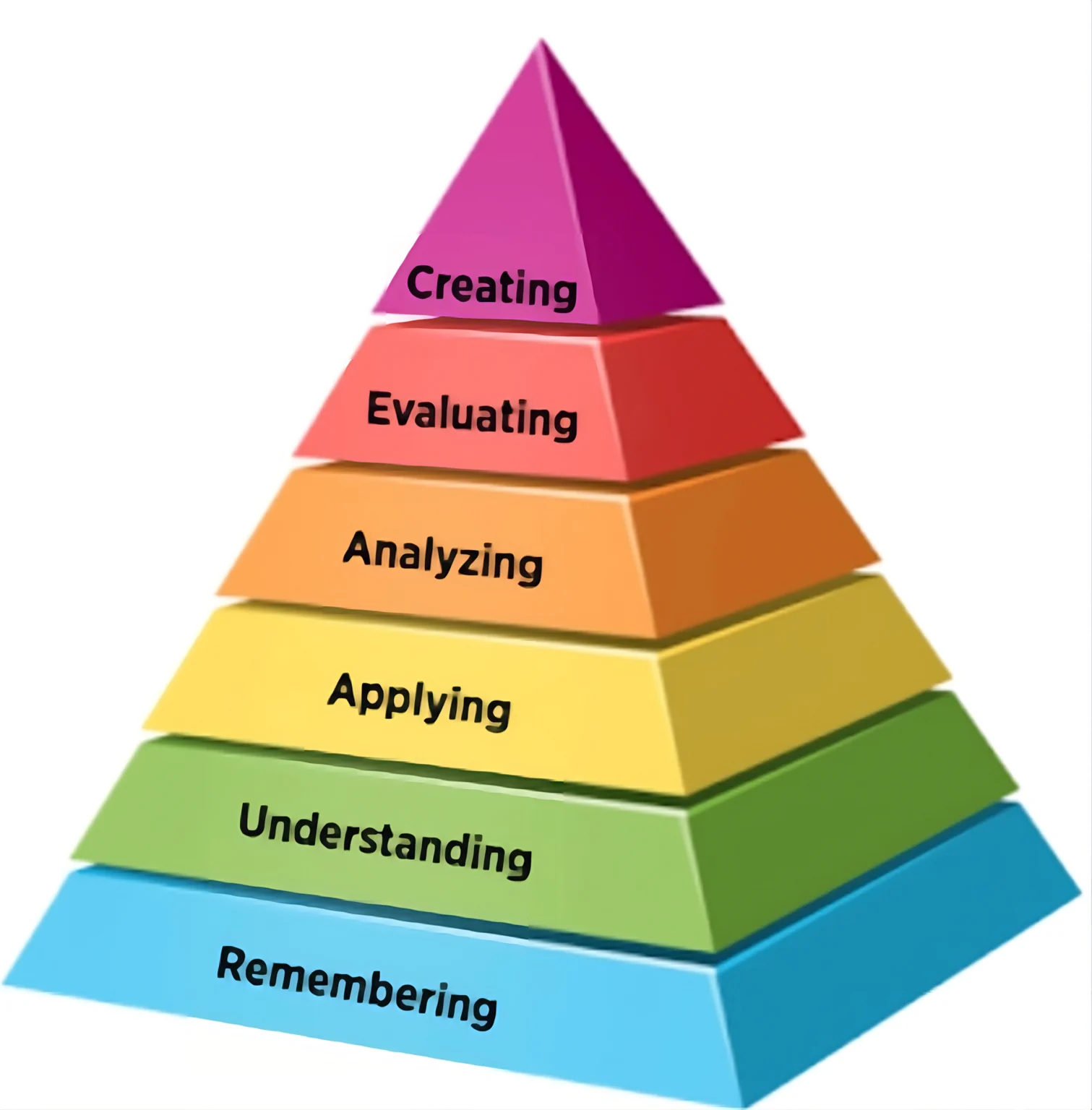
What is Bloom’s Taxonomy?
Bloom’s Taxonomy is a hierarchical model used to classify educational objectives into levels of complexity and specificity. Originally proposed as a triadic model, it categorizes learning into three domains:
- Cognitive: Mental skills and knowledge acquisition.
- Affective: Emotional growth and attitude development.
- Psychomotor: Physical skills and coordination.
The Revised Cognitive Domain: Six Levels of Learning
The revised version of Bloom’s Taxonomy presents six cognitive levels, arranged from basic to advanced. Each level builds upon the previous, creating a scaffold for comprehensive understanding.
1. Remembering
At this foundational stage, learners retrieve and recall information. This includes facts, terms, and basic concepts.
Keywords: Define, List, Memorize, Recall.
Example: Memorizing the periodic table or historical dates
2. Understanding
Learners interpret, summarize, or explain information in their own words, indicating comprehension.
Keywords: Explain, Interpret, Paraphrase, Classify.
Example: Summarizing the main idea of a story or explaining a scientific concept.
3. Applying
This level involves using knowledge in new situations. Learners solve problems or apply concepts to real-world scenarios.
Keywords: Apply, Demonstrate, Solve, Use
Example: Using mathematical formulas to calculate interest or demonstrating a chemical reaction.
4. Analyzing
Learners break down information into parts, identifying relationships and patterns.
Keywords: Analyze, Compare, Contrast, Differentiate
Example: Comparing themes in literature or analyzing data trends in a graph.
5. Evaluating
At this stage, learners make judgments based on criteria and standards. Critical thinking and decision-making are key.
Keywords: Critique, Judge, Assess, Recommend
Example: Evaluating the validity of an argument or reviewing a product’s performance.
6. Creating
The pinnacle of Bloom’s Taxonomy, this level involves generating new ideas, designing solutions, or producing original work.
Keywords: Create, Design, Invent, Compose
Example: Writing a novel, designing a bridge, or developing a business strategy.
Why is Bloom’s Taxonomy Important?
Bloom’s Taxonomy offers numerous benefits for educators and learners alike:
-
Structured Learning: It provides a clear roadmap for lesson planning and assessment.
-
Enhanced Critical Thinking: Encourages learners to progress from rote memorization to higher-order thinking.
-
Customization: Allows educators to tailor activities to diverse learning needs.
How to Use Bloom’s Taxonomy Effectively?
-
Set Clear Objectives: Define specific learning outcomes for each level of the taxonomy.
-
Design Varied Assessments: Incorporate tasks that span all six levels, from quizzes to projects.
-
Encourage Active Learning: Use interactive techniques, like group discussions or hands-on experiments, to foster deeper understanding.
-
Provide Feedback: Offer constructive feedback to guide learners through their cognitive journey.
Conclusion:
Bloom’s Taxonomy is more than just an educational tool; it’s a philosophy that encourages lifelong learning. By progressing through its levels, learners not only acquire knowledge but also develop the critical thinking and creativity needed to navigate an ever-changing world. Whether you’re an educator, a student, or simply someone passionate about learning, Bloom’s Taxonomy can be your blueprint for success.

2iPw328O94hvMFH6c5YnJVZR9SK
2izIziFeORshuWcyoaedW93IJaJ
2j0g68t4EgchbT9rp6LkTnx2jUI
2j1ILuthrVIXNQ8g2JIiUcRdXov